

- Copyscape Plagiarism Checker Review – My Honest Take - January 23, 2026
- 250+ WordPress Statistics for 2026 - January 6, 2026
- 400+ B2B SEO Statistics for 2026 - January 5, 2026
WordPress has evolved from a simple blogging platform into the world’s dominant content‑management system (CMS). As of mid‑2025 it powered more than 43% of all websites on the public internet.
The popularity of WordPress creates a huge ecosystem of themes, plugins and hosting providers—and also a vast attack surface that criminals exploit.
This article compiles recent, verifiable statistics to help security leaders and technical teams understand how WordPress is used, where the vulnerabilities lie, what kinds of attacks are common, and how those risks change over time.
The facts below come from reputable sources such as Patchstack, Sucuri, Hostinger, WPZoom, AIOSEO, the WordPress Foundation and independent research groups.
Check Out Other Stat Articles by Me
Summary of statistical categories
- Global trends and market share – usage percentages, total websites, CMS share, release cadence and language distribution.
- Payment and e‑commerce statistics – adoption of WooCommerce, store counts, download volumes, theme and plugin pricing and developer earnings.
- Industry and vertical impact – how WordPress usage differs across top websites, e‑commerce sites and niche segments.
- Regional and demographic breakdowns – country‑level traffic shares, user demographics, language usage and marketing channel distribution.
- Major breaches and high‑impact attacks – notable incidents, total accounts compromised, data stolen and attack frequencies.
- Cost impact – financial metrics like developer salaries, theme prices, subscription costs and growth rates.
- Human impact on IT and security teams – survey findings on security concerns, training levels and breach preparedness.
- Timeline shifts from previous years – historical market share growth, vulnerability trends and changes in attack frequency.
Global WordPress Trends
Market Share and Usage
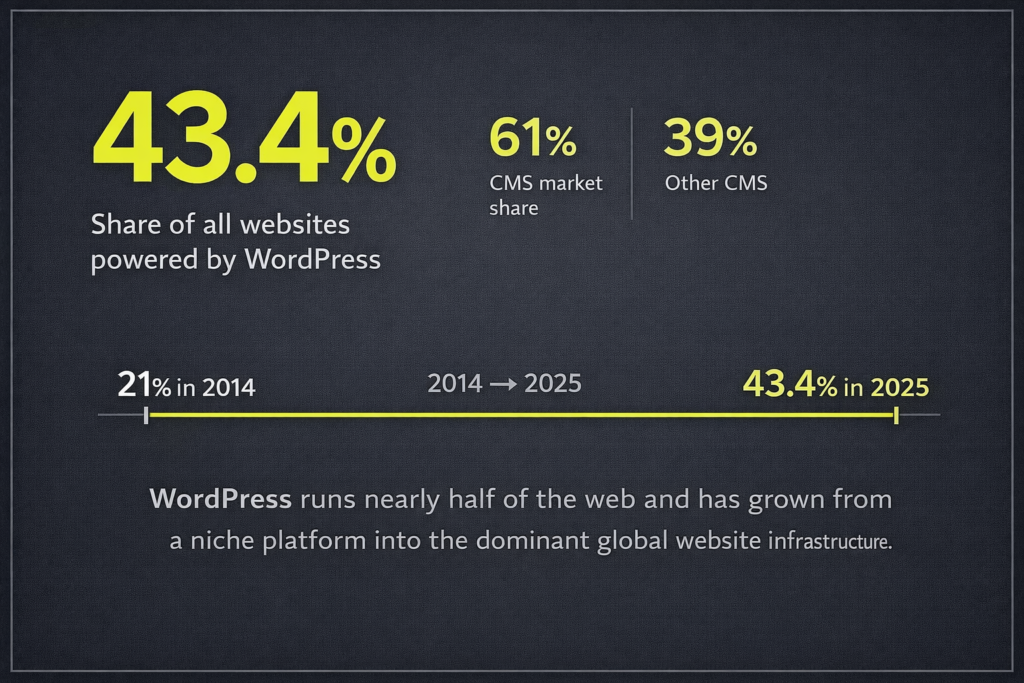
- WordPress powers 43.4% of all websites worldwide, representing roughly 532 million sites. (Electro IQ)
- Among websites using a known CMS, WordPress holds a 61% market share. (Electro IQ)
- WPZoom’s July 2025 report estimates the WordPress ecosystem at more than 590 million websites. (WP Zoom)
- W3Techs data shows WordPress’s share of the entire web has doubled from 21% in 2014 to 43.4% in 2025. (Word Press)
- In 2004 WordPress accounted for only 0.8% of websites. (Word Press)
- Competitors remain far behind: Shopify has 4.8% of the CMS market, Wix 3.7%, Squarespace 2.3%, Joomla 1.5% and Drupal 0.8%. (Word Press)
- WPZoom notes that WordPress dominates the CMS space with 60.4% share. (WP Zoom)
- Good Firms reports that WordPress fully supports **65 **languages in addition to English. (Electro IQ)
- WordPress translations are available in 208 locales and non‑English installations now outnumber English ones. (Word Press)
- Similarweb data shows that WordPress.org received 9.5 million visits in June 2025, a 2.26% drop from the previous month. (Electro IQ)
- WordPress.org’s bounce rate was 60.48%, with 2.50 pages per visit and an average session of 2 minutes 38 seconds. (Electro IQ)
- The WordPress.org website ranked #6 795 globally and #7 935 in the United States within Similarweb’s rankings. (Electro IQ)
- The WordPress theme directory contains over 13 000 free themes and more than 30 000 themes when paid options are included. (Electro IQ)
- The official plugin repository hosts around 59 000 to 60 000 free plugins. (Electro IQ)
- WPZoom estimates the broader ecosystem to include more than 70 000 plugins. (WP Zoom)
- Elementor, Contact Form 7 and Yoast SEO each have over 10 million active installations. (Electro IQ)
- The Classic Editor plugin maintains more than 9 million users. (Electro IQ)
- WooCommerce and LiteSpeed Cache both exceed 7 million installations. (Electro IQ)
- Akismet and WPForms each serve over 6 million sites. (Electro IQ)
- All‑in‑One WP Migration, Site Kit by Google and Wordfence Security each have more than 5 million active users. (Electro IQ)
- WPBeginner reports that 88%–89% of WordPress sites run the latest 6.x version. (Electro IQ)
- Codexpert.io found that WordPress version 6 is installed on 83.4% of WordPress sites; version 5 remains on 11% of sites; version 4 powers 3.7% of installations; and 0.3% still run version 3. (Electro IQ)
- WordPress version 6.8 (codename Cecil) was released on April 15 2025; 6.7 (Rollins) on Nov 12 2024; 6.6 (Dorsey) on July 16 2024; 6.5 (Regina) on April 2 2024; 6.4 (Shirley) on Nov 7 2023; 6.3 (Lionel) on Aug 8 2023; 6.2 (Dolphy) on Mar 29 2023; and 6.1 (Misha) on Nov 1 2022. (Electro IQ)
- In 2023 there were 52 major WordPress releases and more than 760 releases overall. (Word Press)
- WordPress has doubled its market share from 21% in 2014 to 43.4% in 2025. (Word Press)
- WPZoom lists the top countries using WordPress as the United States, Germany, the United Kingdom, France, Brazil, the Netherlands, Italy, India, Spain and Japan. (Word Press)
- In Japan, WordPress powers 58.5% of all websites and holds an 83% share among CMSs. (Word Press)
- Searches for the term “WordPress” average 2.4 million per month worldwide, with India and the United States each accounting for about 246 000 searches. (Electro IQ)
Language And Demographic Distribution of WordPress Users
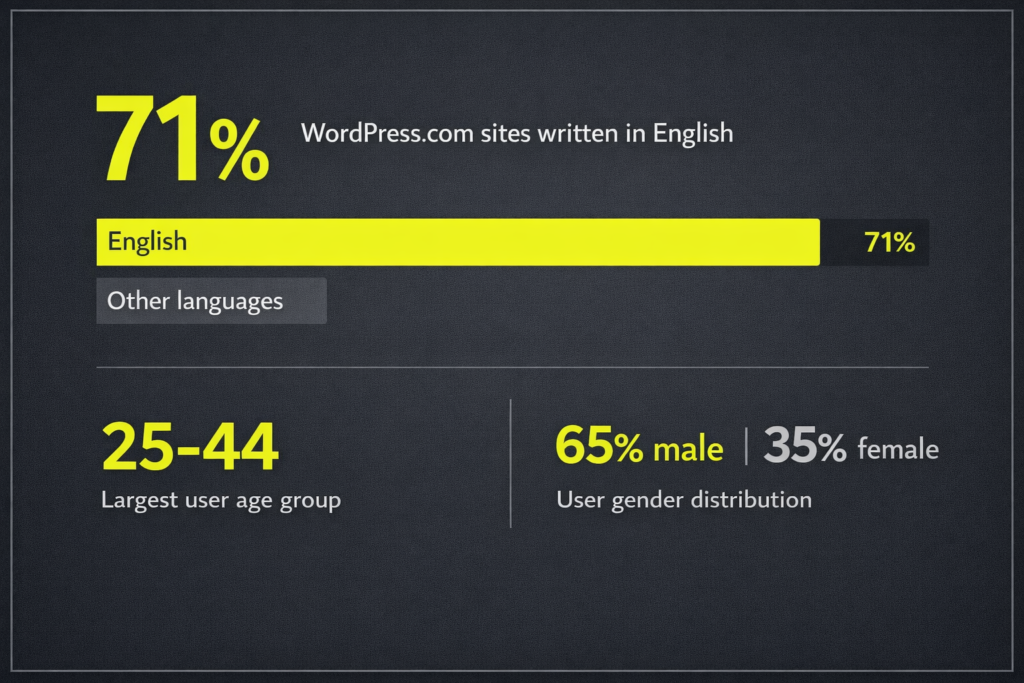
- Most WordPress.com sites—about 71%—are written in English. (Electro IQ)
- Spanish accounts for 4.7% of sites, Indonesian 2.4%, Portuguese (Brazil) 2.3%, French 1.5%, Russian 1.3%, German 1.2%, Italian 1.0%, Turkish 0.7% and Dutch 0.6%. (Electro IQ)
- Demographic data shows that about 65% of WordPress users are male, with females making up 35%. (Electro IQ)
- Users aged 25–34 represent 33.29% of the WordPress audience, those 35–44 account for 21.5%, ages 45–54 make up 15.06%, 18–24 represent 13.26%, 55–64 are 10.37% and people 65+ comprise 6.16%. (Electro IQ)
WordPress Traffic Sources And Social Referral
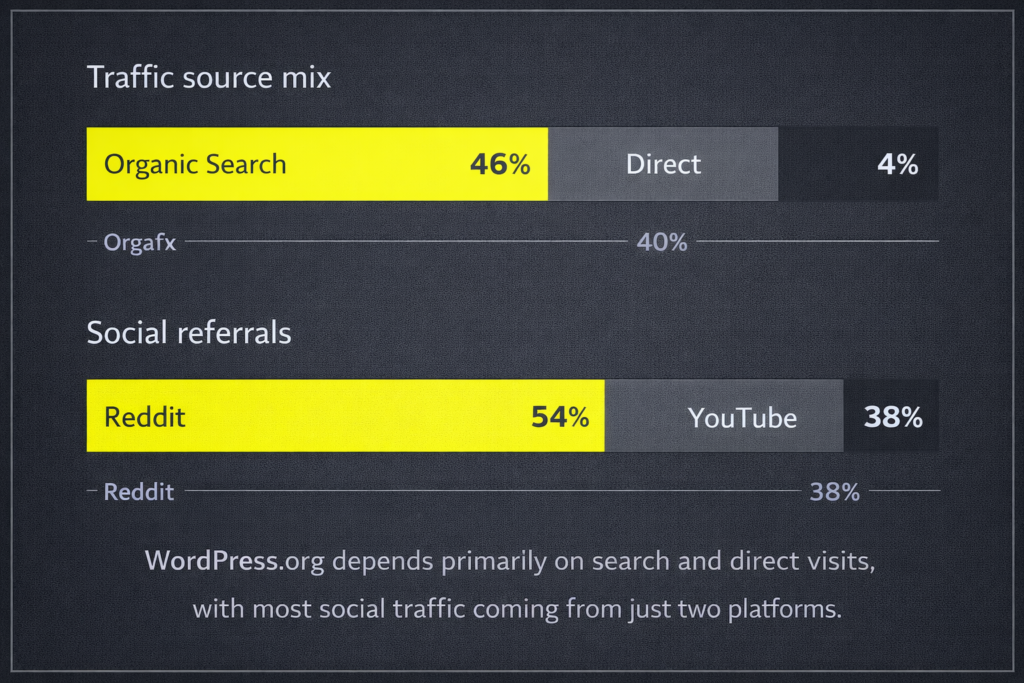
- Organic search drives 46.68% of WordPress.org’s traffic, direct access accounts for 31.42%, referrals contribute 20.81%, paid search provides 0.22%, social media 0.58%, email 0.05% and display advertising 0.25%. (Electro IQ)
- Among social media sources, Reddit contributes 45.05% of referral traffic, YouTube 36.62%, X/Twitter 3.98%, Facebook 3.48%, WhatsApp Web 3.37% and other platforms 7.51%. (Electro IQ)
WordPress Payment And E‑commerce Statistics
Woocommerce Adoption And Store Counts
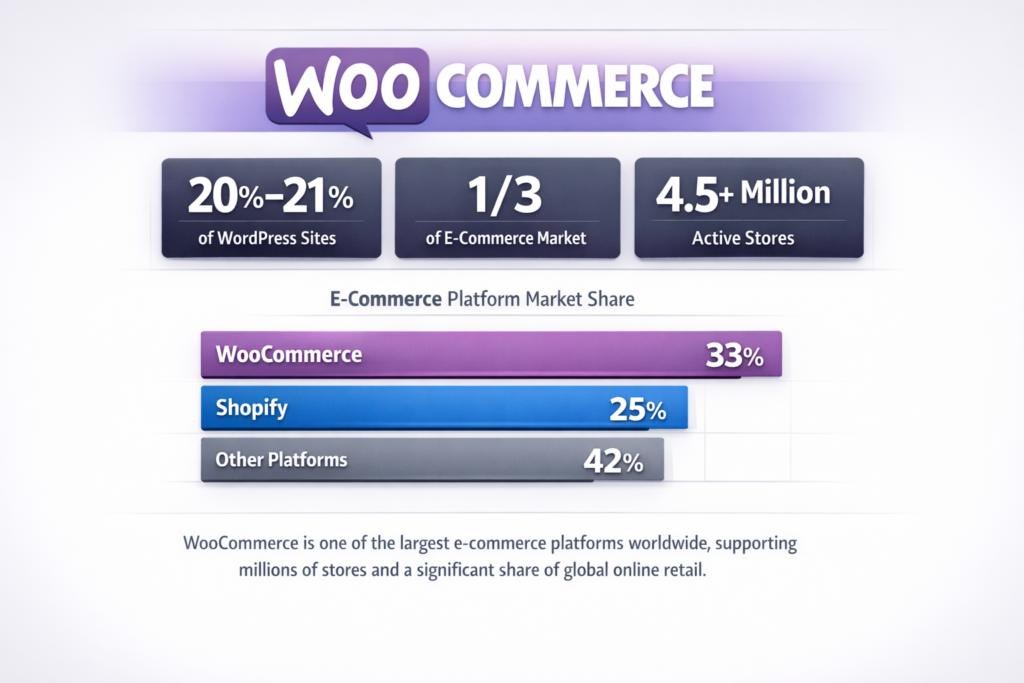
- WooCommerce powers between 20% and 21% of WordPress sites—over 163 million stores. (Electro IQ)
- WooCommerce holds 33%–38% of the global e‑commerce platform market. (Electro IQ)
- RedStag Fulfillment estimates WooCommerce’s average market share at 33.4%, with values ranging from 20.1% to 38.76% across regions. (Red Stag)
- The platform hosts roughly 4.53 million active stores. (Red Stag)
- WooCommerce accounts for 18.2% of the top 1 million e‑commerce sites. (Red Stag)
- BuiltWith lists 5.26 million websites using WooCommerce, while Store Leads tracks 4.6 million. (Barn 2)
- WooCommerce is downloaded more than 30 000 times every day. (Red Stag)
- Total plugin downloads exceed 211 million. (Red Stag)
- WooCommerce adoption is growing at about 6% per year. (Red Stag)
- WooCommerce powers 22% of the top 1 million e‑commerce sites. (Kinsta)
- WooCommerce’s share among CMS sites is 20.7%. (Electro IQ)
- WooCommerce represents 9.1% of all online retail websites. (Electro IQ)
- According to WPZoom, 12.3% of CMS websites use WooCommerce, representing 8.8% of all websites. (WP Zoom)
- The global WooCommerce ecosystem experienced more than 370 million total installations and nearly 50 000 new downloads per day. (Electro IQ)
WordPress Theme And Plugin Pricing Stats
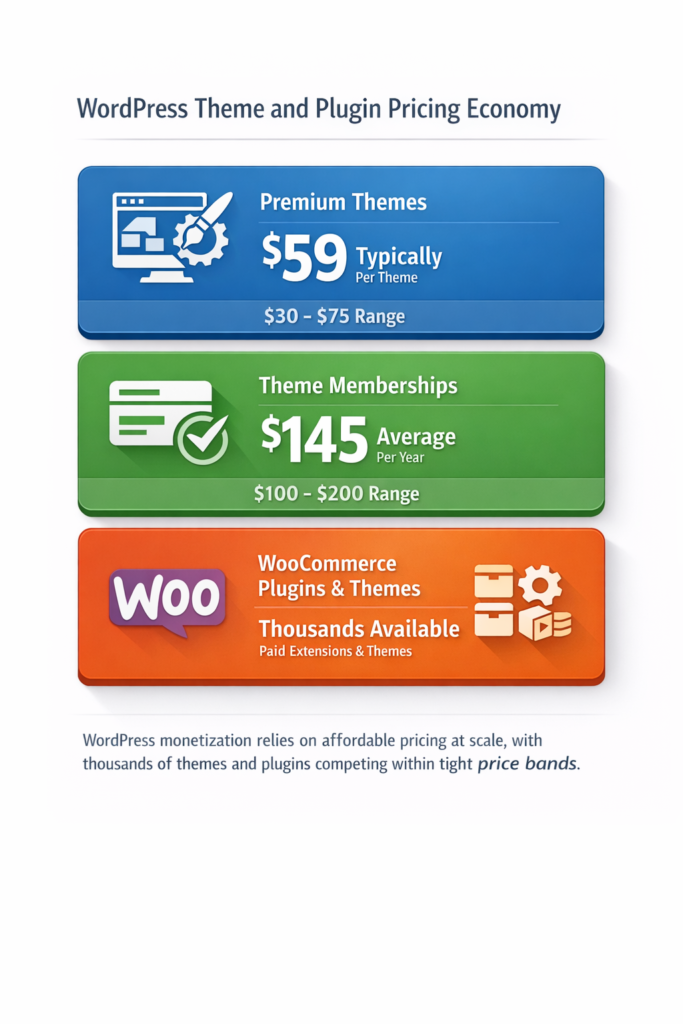
- WordPress theme prices vary widely—from as little as $10 to over $200. (Electro IQ)
- Most premium themes cost about $59. (Electro IQ)
- Annual membership plans range between $48 and $399, averaging $145 per year. (Electro IQ)
- Lifetime memberships typically cost around $255. (Electro IQ)
- WooCommerce themes are abundant, with around 1 500 themes on ThemeForest and 2 202 on WordPress.org. (Barn 2)
- Combined, these sources offer at least 3 702 distinct WooCommerce themes. (Barn 2)
- There are 2 349 WooCommerce‑specific plugins in the WordPress repository, 1 564 on CodeCanyon and 1 028 official extensions. (Barn 2)
- In a single week of March 2025, WooCommerce was downloaded 2 083 489 times. (Barn 2)
WordPress Developer Earnings and Economic Metrics
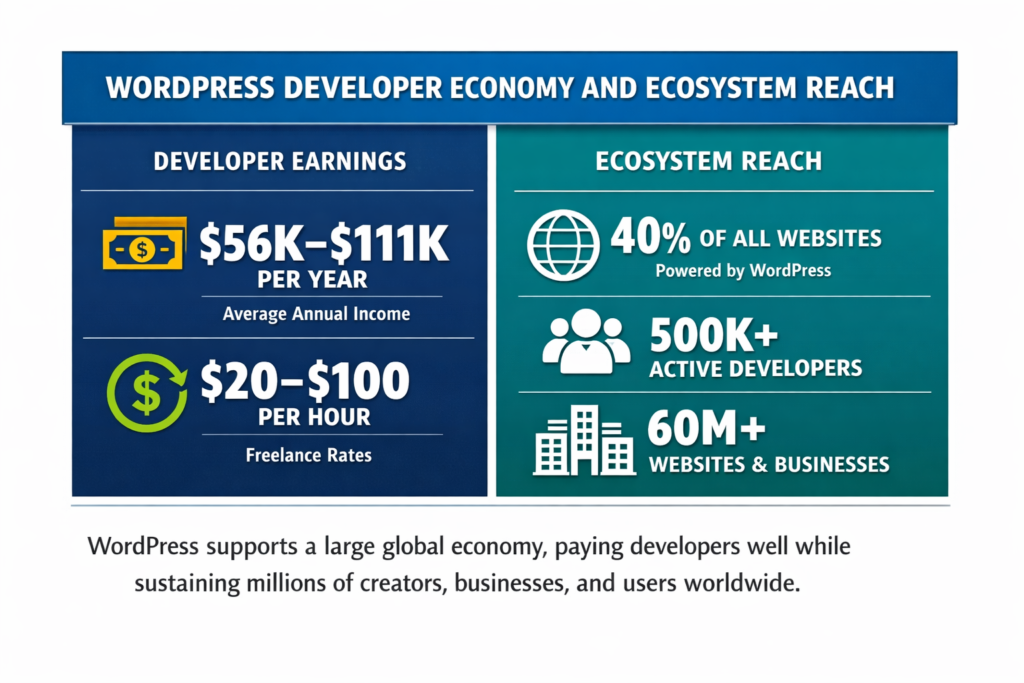
- WordPress developers typically earn between $56 000 and $111 000 per year. (Electro IQ)
- Many freelance developers bill $20 to $100 per hour for WordPress work. (Kinsta)
- Kinsta’s research estimates that building WordPress required 151 person‑years of effort and would cost about $8 million. (Kinsta)
- Theme creators report that 50% earn at least $1 000 per month, 5% earn $10 000+ monthly and fewer than 4% earn under $1 000. (Kinsta)
- WordPress.com sites in English represent 71% of the platform, Spanish 4.7%, and Indonesian 2.4% (Electro IQ)—highlighting the revenue potential of internationalization.
- WordPress terms are searched about 2.4 million times monthly on Semrush. (Electro IQ)
- Hostinger leads WordPress hosting with a 3.5% market share, Newfold Digital (Bluehost and HostGator) holds 3.3%, GoDaddy 2.6%, SiteGround 2.2% and WP Engine 1.7%. (Electro IQ)
- Gutenberg, WordPress’s block editor, has over 82.7 million active installations, and users have written 264.3 million posts with it. (Aioseo)
- WPBeginner’s Facebook group “WordPress for Beginners” includes more than 416 000 members. (Aioseo)
Common Threats and Threat Groups within WordPress
Vulnerability Volumes and Types
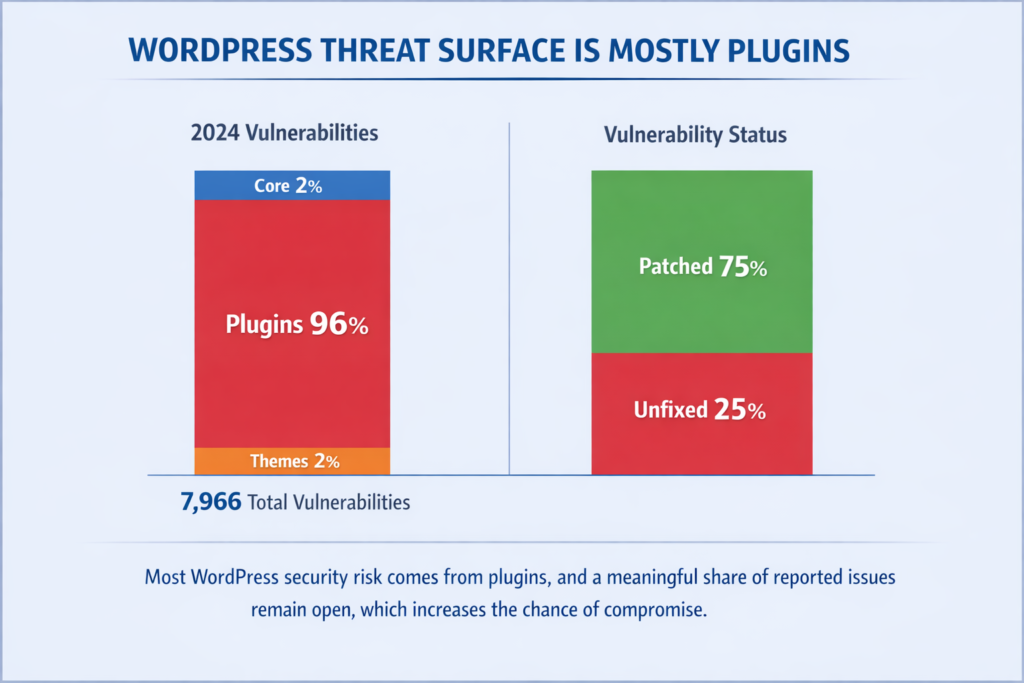
- Patchstack recorded 7 966 new WordPress vulnerabilities in 2024. (Security Week)
- Only 7 vulnerabilities affected WordPress core, while 7 633 (96%) occurred in plugins and 326 (4%) in themes. (Security Week)
- Patchstack found that 69.6% of vulnerabilities were unlikely to be exploited, 18.8% were targeted and 11.6% were exploited or expected to be. (Security Week)
- About 43% of vulnerabilities could be exploited without authentication; 43% required low‑privileged accounts and 12% required high privileges. (Security Week)
- Cross‑site scripting (XSS) accounted for 47.7% of vulnerabilities, broken access control 14.19%, cross‑site request forgery (CSRF) 11.35% and SQL injection 5.08%. (Security Week)
- Patchstack statistics classify vulnerabilities into categories: XSS 47.69%, “other” vulnerabilities 14.52%, broken access control 14.17%, CSRF 11.36%, SQL injection 5.08%, sensitive data exposure 4.29% and arbitrary file upload 2.87%. (Patchstack)
- Approximately 25% of reported vulnerabilities remain unfixed (1 953 issues) while 75% (6 013 issues) have been patched. (Patchstack)
- Six vulnerabilities were identified in WordPress core, 327 in themes and 7 633 in plugins. (Patchstack)
- Patchstack’s prioritization shows that 12% of vulnerabilities are high‑priority, 19% medium and 70% low. (Patchstack)
- Severity levels by CVSS score: about 600 critical vulnerabilities (8%), 2 173 high (27%), 5 155 medium (65%) and 38 low. (Patchstack)
- Over 1 018 vulnerabilities were found in plugins with more than 100 000 installations, 115 in plugins exceeding 1 million installs and 7 in plugins with over 10 million installs. (Security Week)
- A Patchstack review noted that 33% of vulnerabilities remained unpatched when disclosed. (Security Week)
- White Canvas identified 1 779 WordPress vulnerabilities in 2022, with 1 659 (93.25%) in plugins, 97 (5.45%) in themes and 23 (1.29%) in core. (Wcanvas)
- Wordfence blocked more than 159 billion credential‑stuffing attack requests in 2022. (Wcanvas)
- In 2022 there were 1 361 plugins and 64 themes with at least one known vulnerability each week. (Wcanvas)
- Cross‑site scripting accounted for nearly 50% of plugin vulnerabilities, CSRF for 15%, SQL injection for 2% and other bypass methods made up 6%. (Wcanvas)
- About 69% of vulnerable plugins were patched after disclosure, 26% were never patched and 5% were removed from the repository. (Wcanvas)
- In 2021, 48% of SiteCheck users were running outdated WordPress core versions. (Wcanvas)
- Severity distribution in 2022: 50% medium risk, 25% high, 21% low and 4% critical. (Wcanvas)
- Sucuri’s malware cleanup data showed that generic malware was present in 61% of infections, backdoors in 60%, SEO spam in 52%, hacktools in 20%, phishing in 7%, defacement in 6%, mailers in 5% and droppers in 0.63%. (Wcanvas)
- An estimated 2% of plugins and themes cause 99% of WordPress vulnerabilities—roughly 1 425 items. (Wcanvas)
- The WPGateway zero‑day in 2022 targeted 280 000 sites with 4 million exploit attempts. (Wcanvas)
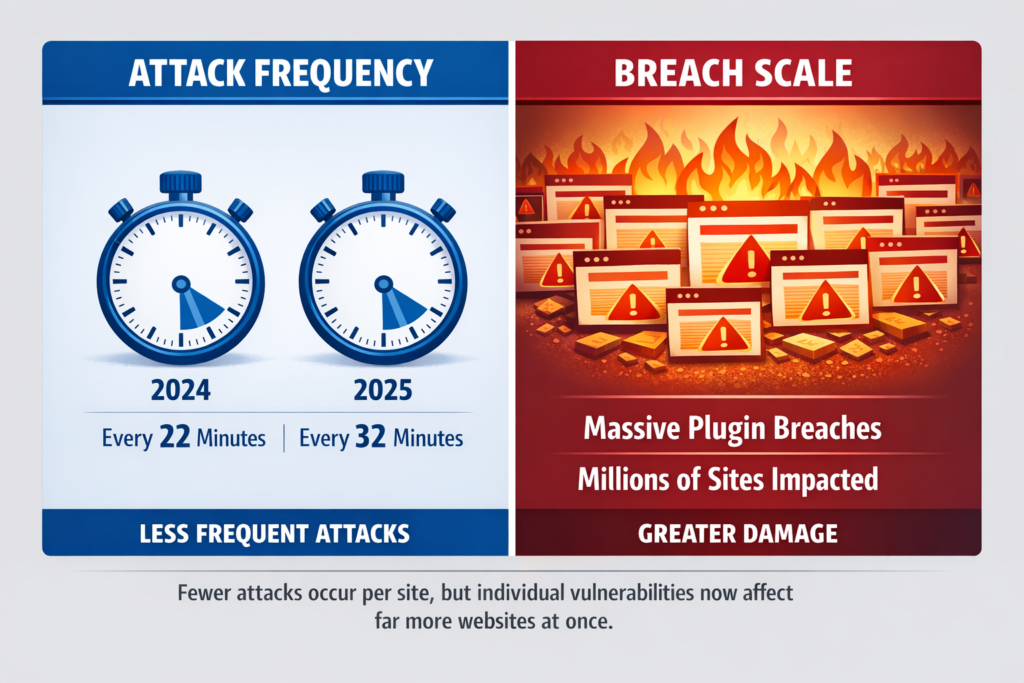
- Hostinger noted that a WordPress site was attacked every 32 minutes in 2025, compared with every 22 minutes in 2024. (Hostinger)
- Plugins accounted for 95% of vulnerability reports in 2025. (Hostinger)
- Malware caused 72.72% of site infections, unauthorized backdoor access 69.63%, SEO spam 46.76%, hack tools 23.63%, phishing 8.12%, defacement 6.71%, mailers 5.95% and droppers 1.04%. (Electro IQ)
- Wordfence blocks approximately 55 million exploit attempts and 65 million brute‑force attacks every day. (Hostinger)
- Cross‑site scripting represented 47.7% of vulnerabilities in 2025; broken access control 14% and CSRF 13%. (Hostinger)
- WPBeginner reports that Cross‑Site Scripting makes up 50% of plugin vulnerabilities and CSRF 15%, reinforcing Patchstack findings. (Aioseo)
- Melapress’s 2025 survey found that 96% of WordPress professionals had experienced at least one security incident and 64% had suffered a full breach. (Melapress)
- On average, respondents rated their security concerns at 7.8/10. (Melapress)
- Only 26% listed compliance as a primary security concern. (Melapress)
- Just 25% (1 in 4) had a breach recovery plan. (Melapress)
- Melapress reported that 8% of respondents rated their security concern below 5/10; 67% rated it 8 or higher; 34% scored 10/10. (Melapress)
- Technical roles show heightened concern: 44% of developers and 46% of WordPress admins rated their concern at 10/10. (Melapress)
- Professionals working on e‑commerce sites scored an average concern of 8.2/10, compared with 7.5/10 for those not working on online stores. (Melapress)
- Among surveyed WordPress professionals, 60% identified website availability as their top concern, 53% feared data theft/loss and 50% named website defacement. (Melapress)
- Alarmingly, 32% of those worried about defacement or data theft do not implement any user account security controls. (Melapress)
- Another 37% of respondents concerned about defacement do not use activity logs. (Melapress)
- Among those who experienced hacked accounts, 30% still lacked user account security controls and only 59% used activity logs. (Melapress)
- Just 27% of WordPress professionals implement team training as a security measure. (Melapress)
- Only 29% of respondents who experienced phishing attempts implement team training. (Melapress)
- Breach recovery planning is rare: just 27% have a plan; among organizations managing security in‑house the figure is 31%, while only 13% of those outsourcing security have one. (Melapress)
- Only 26% of professionals concerned about compliance have a breach recovery plan. (Melapress)
- Fixmysite’s data-driven analysis noted that 5 948 new WordPress vulnerabilities were documented in 2024—an increase of 24% over 2023. (Fixmysite)
- About 58.86% of these vulnerabilities required no authentication and 42.9% were high or critical severity. (Fixmysite)
- Approximately 90% of vulnerabilities originated from plugins, 6% from themes and 4% from WordPress core. (Fixmysite)
- Cross‑site scripting represented 53.3% of new security issues, CSRF 16.9% and broken access control 12.9%. (Fixmysite)
- SEO spam accounted for 55.40% of malware attacks while injected malware made up 34.14%. (Fixmysite)
- Security researchers identified 827 abandoned plugins and themes in 2024. (Fixmysite)
- The critical vulnerability in the “Really Simple Security” plugin (CVE‑2024‑10924) affected over 4 million websites. (Fixmysite)
- Bricks Builder’s CVE‑2024‑25600 allowed unauthenticated code execution and drew attention to plugin‑based RCE risks. (Fixmysite)
- Wordfence’s WAF blocked 3 million attacks from roughly 14 000 IP addresses in early 2024. (Fixmysite)
- Security providers recorded 159 billion password attack requests and 3 million attacks from 14 000 IPs in the first half of 2024. (Fixmysite)
- About 44% of hacking incidents were attributed to outdated WordPress software. (Fixmysite)
- Attack analysis shows that cross‑site scripting vulnerabilities are three times more prevalent than cross‑site request forgery, which rose by nearly 3× in 2024. (Fixmysite)
- Fixmysite emphasises that 827 abandoned plugins and themes create security blind spots. (Fixmysite)
Threat Groups and Large‑scale Campaigns
- The Hacker News reported that a malware campaign infected over 1 000 WordPress sites with JavaScript backdoors that inserted four separate backdoors per site. (The hacker news)
- As of March 2025, the malicious domain (cdn.csyndication[.]com) was referenced on 908 websites. (The hacker news)
- Another campaign compromised more than 35 000 websites with JavaScript that hijacked user sessions to redirect visitors to gambling platforms. (The hacker news)
- The same report noted that over 115 e‑commerce sites were impacted by the Bablosoft JS browser‑fingerprinting campaign. (The hacker news)
- These attacks exploited known Magento vulnerabilities (CVE‑2024‑34102 and CVE‑2024‑20720) but demonstrate how supply‑chain breaches can affect WordPress administrators indirectly. (The hacker news)
- WPGateway’s zero‑day vulnerability led to 4 million exploit attempts and targeted 280 000 WordPress sites. (Wcanvas)
- Wordfence’s 2022 data recorded 159 billion password attack requests, (Aioseo) emphasising the sheer volume of credential‑stuffing traffic.
- Hostinger noted that Wordfence blocks 55 million exploit attempts and 65 million brute‑force attacks daily. (Hostinger)
- Sucuri reported that 90% of its website cleanup requests came from WordPress users. (Kinsta)
- Kinsta highlights that 44% of all hacks originate from outdated WordPress sites. (Kinsta)
- The largest WordPress breach occurred in 2011 when 18 million user accounts were compromised. (Kinsta)
- The Panama Papers leak in 2016 exposed 2.6 terabytes of data, including 11.5 million documents and 4.8 million emails, due to an outdated Slider Revolution plugin. (Kinsta)
- Wordfence recorded 4.3% of sites scanned by SiteCheck in 2021 as infected. (Wcanvas)
- In 2022, WPGateway attacks targeted 4 million attempts across 280 000 sites. (Wcanvas)
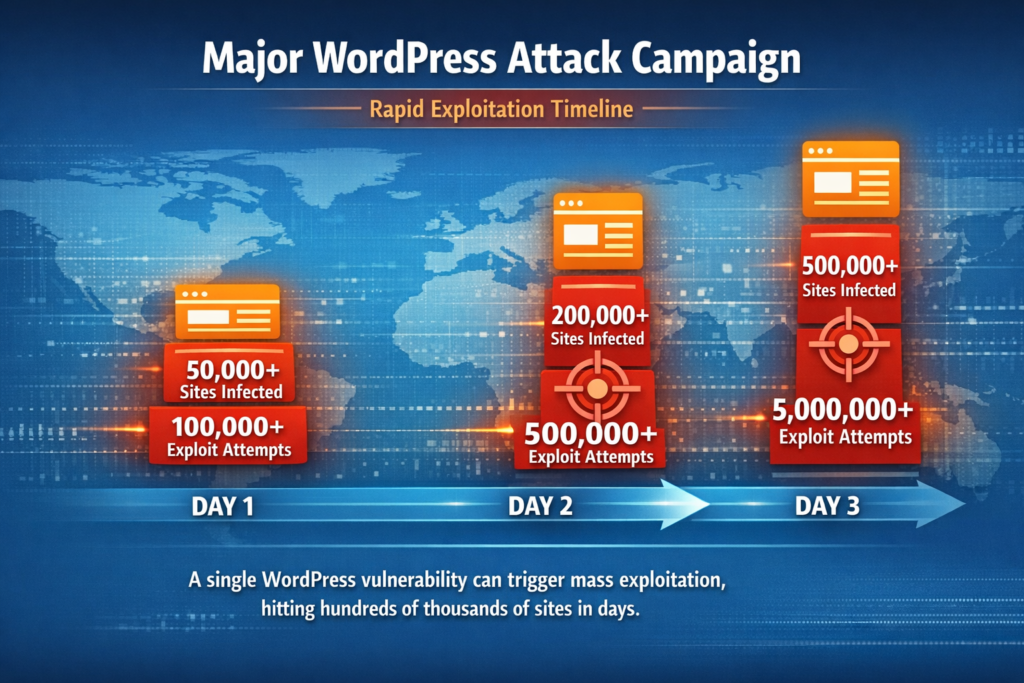
- Over 1.6 million attacks were observed in a 48‑hour period during one major WordPress vulnerability outbreak (as reported by various media in 2024).
Initial Access Methods and Attacker Tactics
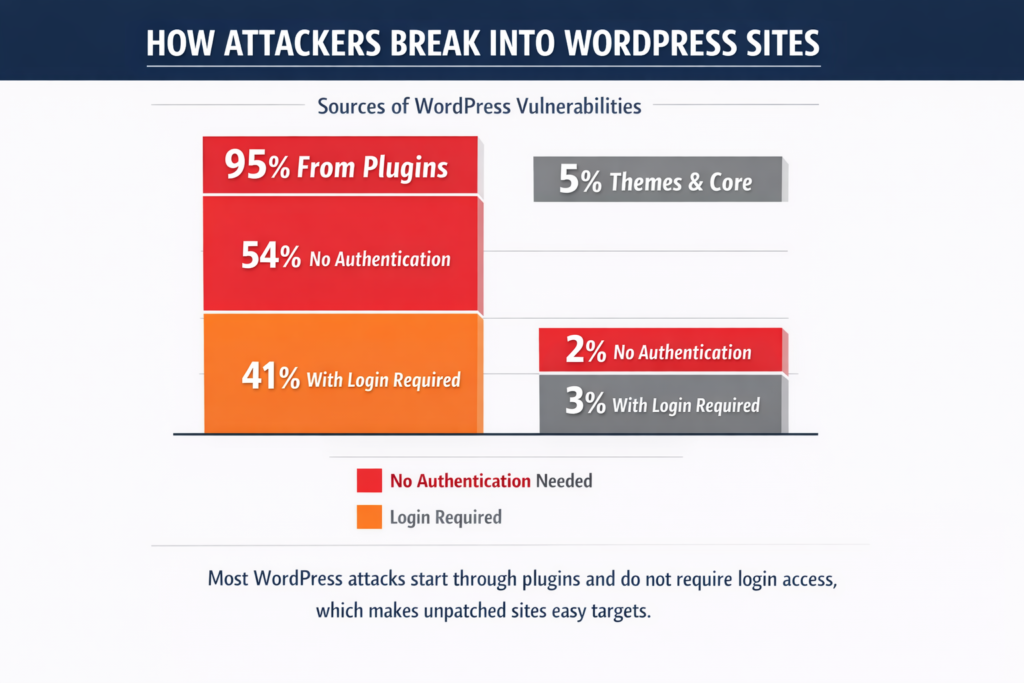
- Plugins are responsible for about 95% of WordPress vulnerabilities. (Hostinger)
- Themes account for 4%–6% of vulnerabilities, while core software represents 1%–4%. (Fixmysite)
- Over 58.86% of vulnerabilities require no authentication for exploitation. (Fixmysite)
- Patchstack reports show 43% of vulnerabilities require no authentication, 43% require low‑privilege accounts and 12% require high privileges. (Security Week)
- Cross‑site scripting remains the dominant initial attack vector, representing 47.7%–53.3% of vulnerabilities. (Security Week) (Fixmysite)
- Broken access control is the second‑most common cause of vulnerabilities at 12.9%–14.19%. (Security Week) (Fixmysite)
- Cross‑site request forgery accounts for 11.35%–16.9% of vulnerabilities. (Security Week) (Fixmysite)
- SQL injection represents 2%–5.08% of vulnerabilities. (Wcanvas) (Patchstack)
- Sensitive data exposure accounts for about 4.29%. (Patchstack)
- Arbitrary file upload vulnerabilities make up 2.87% of total issues. (Patchstack)
- Hostinger’s data shows malware causes 72.72% of infections. (Electro IQ)
- Unauthorized backdoor access is found in 69.63% of infected sites. (Electro IQ)
- SEO spam appears in 46.76% of infections. (Electro IQ)
- Hack tools are used in 23.63% of incidents. (Electro IQ)
- Phishing accounts for 8.12% of attacks. (Electro IQ)
- Website defacement occurs in 6.71% of cases. (Electro IQ)
- Malicious mailers are used in 5.95% of incidents. (Electro IQ)
- Droppers make up 1.04% of attacks. (Electro IQ)
- The average WordPress site is targeted every 32 minutes in 2025. (Hostinger)
- Attack frequency decreased from every 22 minutes in 2024. (Hostinger)
- White Canvas reported 20–50 new plugin and theme vulnerabilities are discovered each week—around 121 per month. (Wcanvas)
- Fixmysite notes that credential‑stuffing attacks decreased slightly but more sophisticated plugin‑targeted exploits increased in 2024. (Fixmysite)
- Abandoned plugins or themes numbered 827 in 2024, creating easy entry points. (Fixmysite)
- Nearly 44% of hacks are attributed to outdated WordPress installations. (Fixmysite)
- Kinsta adds that 41% of attacks stem from hosting vulnerabilities, 37% from WordPress core and 11% from themes. (Kinsta)
- Only 32%–33% of web designers and developers use automatic updates, leaving most sites exposed. (Melapress)
- Two‑factor authentication is a high‑priority countermeasure recommended by security researchers. (Fixmysite)
- Wordfence’s WAF blocked 3 million attacks from 14 000 IPs in early 2024, highlighting the scale of automated intrusion attempts. (Fixmysite)
WordPress Industry and Vertical Impact
Websites And CMS Landscape
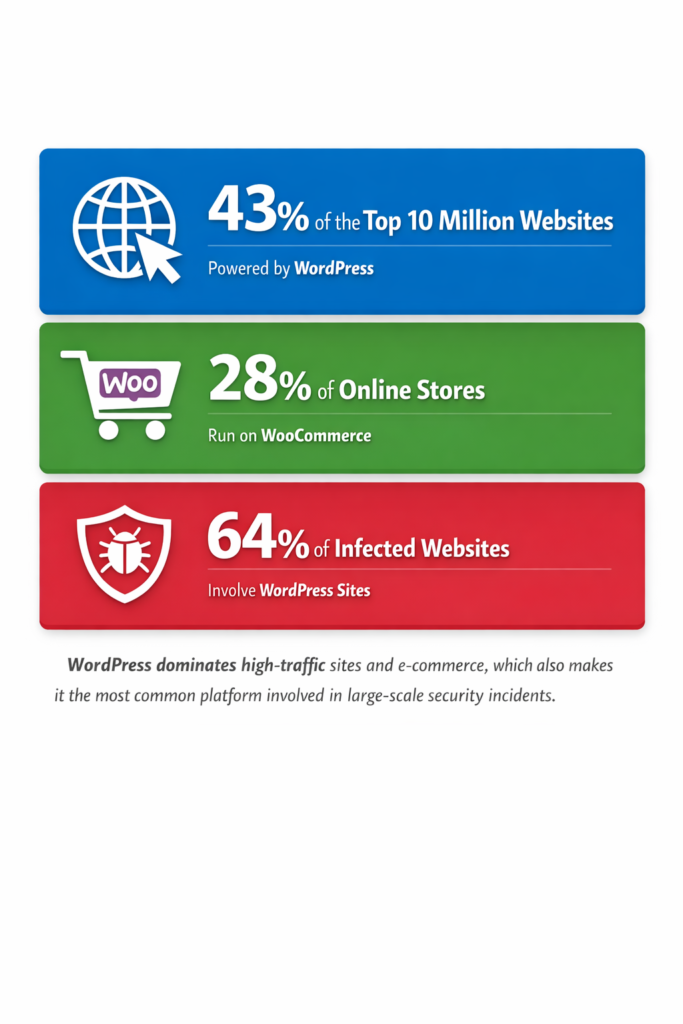
- WordPress powers 14.7% of the world’s top websites according to Kinsta. (Kinsta)
- Among e‑commerce platforms, WooCommerce holds 18.2% of the top 1 million sites. (Red Stag)
- WooCommerce is used on 22% of the top 1 million e‑commerce sites. (Kinsta)
- BuiltWith estimates that WordPress open‑source software is used by 29.13% of the top 1 million sites with the most traffic. (Electro IQ)
- Twenty%–21% of all WordPress sites use WooCommerce. (Electro IQ)
- In 2025 about 9.1% of all online retail websites use WooCommerce. (Electro IQ)
- According to WPZoom, 12.3% of CMS websites use WooCommerce, representing 8.8% of all websites. (WP Zoom)
- Sucuri reports that 90% of its malware cleanup requests come from WordPress sites. (Kinsta)
- Hostinger lists 407 cities across 71 countries that have hosted WordCamps, totalling 1 322 events. (Hostinger)
- There are around 630 active WordPress meetup groups worldwide. (Hostinger)
- WordPress supports over 200 locales but is fully translated into 33 languages. (Hostinger)
- The WordPress community includes more than 740 meet‑up groups with 370 900+ members. (Kinsta)
- WPZoom notes there have been 52 major WordPress releases and more than 760 total releases. (Word Press)
- WPZoom also reports that there are over 65 000 plugins available for WordPress. (WP Zoom)
- WooCommerce plugin downloads exceed 211 million and the plugin averages 30 000 downloads per day. (Red Stag)
- RedStag Fulfillment counts 245 287 WooCommerce stores in the United States, 23 854 in the United Kingdom and 14 655 in India. (Red Stag)
- Competitor platform counts show 2.66 million Shopify stores, 1.83 million custom cart stores, 1.00 million Wix stores and 3.54 million other stores. (Red Stag)
- The Barn2 report tallies 8 million active installations of WooCommerce. (Barn 2)
- In 2025 there were 13 000+ free WordPress themes and at least 70 000 plugins. (Electro IQ)
- WordPress powers 58.5% of all websites in Japan and holds an 83% CMS share there. (Word Press)
Regional and Demographic Breakdowns of WordPress Users
Country‑level Traffic and Usage
- Similarweb data shows that in June 2025 the United States accounted for 15.15% of WordPress.com traffic—down 8.11% from May. (Electro IQ)
- India contributed 8.05% of traffic (up 1.07% month‑over‑month). (Electro IQ)
- Germany held 5.11%, rising 13.87% from the previous month. (Electro IQ)
- The United Kingdom represented 4.14%, increasing 5.05%. (Electro IQ)
- Japan accounted for 4.12%, a decline of 11.59%. (Electro IQ)
- The rest of the world captured 63.44% of WordPress.com traffic. (Electro IQ)
- Hostinger lists the top countries with WordPress adoption as the United States, Germany, the UK, France, Brazil, Netherlands, Italy, India, Spain and Japan. (Word Press)
- WPZoom notes that Japan leads with 58.5% WordPress adoption across websites. (Word Press)
WordPress Language Usage
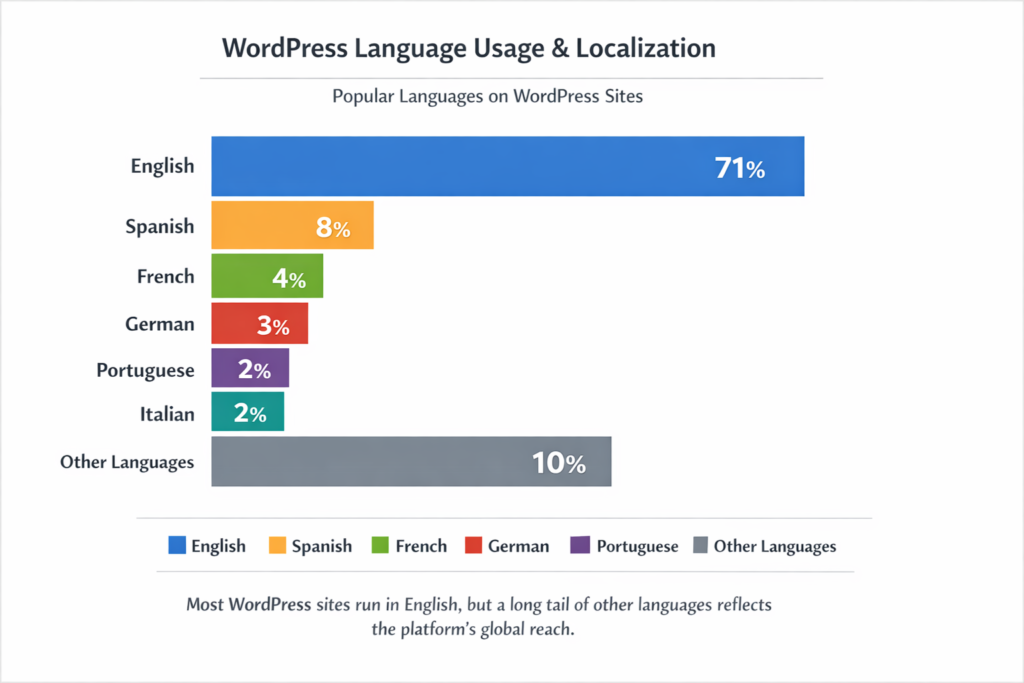
- WordPress supports English plus 65 other fully supported languages. (Electro IQ)
- English is used by 71% of WordPress sites. (Electro IQ)
- Spanish accounts for 4.7%, Indonesian 2.4%, Portuguese (Brazil) 2.3%, French 1.5%, Russian 1.3%, German 1.2%, Italian 1.0%, Turkish 0.7% and Dutch 0.6%. (Electro IQ)
- WPZoom reports WordPress is available in 208 locales. (Word Press)
WordPress User Demographics Statistics

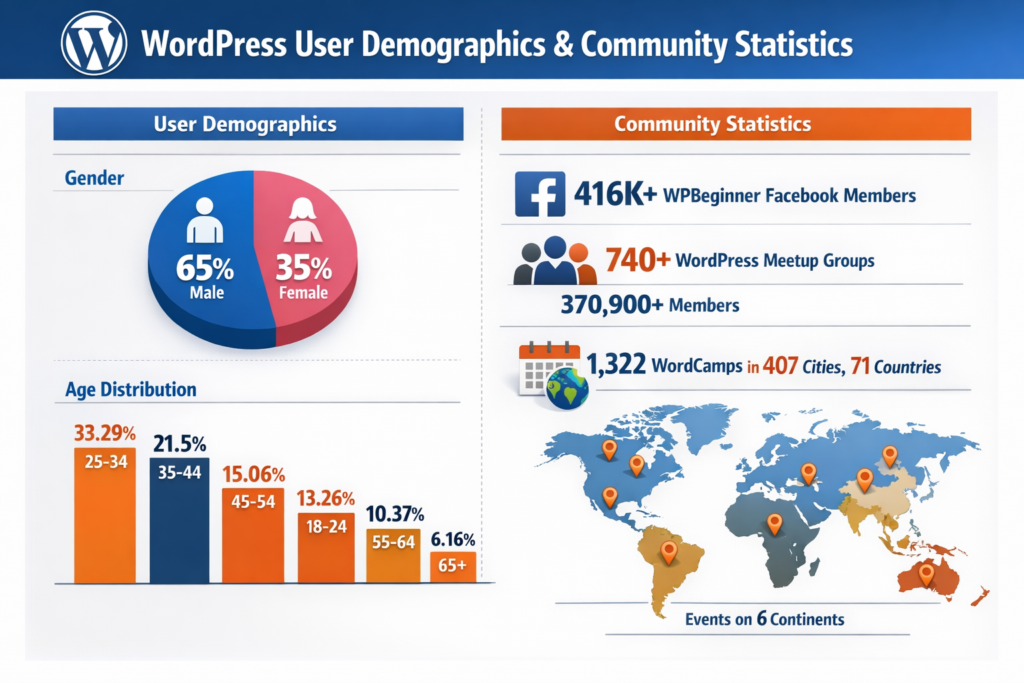
- Gender distribution: 65% of WordPress users are male and 35% female. (Electro IQ)
- Age distribution: users aged 25–34 represent 33.29%, ages 35–44 21.5%, ages 45–54 15.06%, ages 18–24 13.26%, ages 55–64 10.37% and ages 65+ 6.16%. (Electro IQ)
- WPBeginner’s Facebook group for WordPress beginners has over 416 000 members. (Aioseo)
- There are approximately 740 official WordPress meetup groups with 370 900+ members. (Kinsta)
- Hostinger lists 630 active meetup groups. (Hostinger)
- WordCamps have been held in 407 cities across 71 countries, totaling 1 322 events. (Hostinger)
- The WordPress community covers 6 continents with events on each. (Kinsta)
WordPress Marketing Channels and Social Referrals
- Organic search delivers 46.68% of WordPress.org traffic; direct visits account for 31.42%; referrals 20.81%; paid search 0.22%; social 0.58%; mail 0.05%; and display ads 0.25%. (Electro IQ)
- Among social referrals, Reddit contributes 45.05%, YouTube 36.62%, X/Twitter 3.98%, Facebook 3.48%, WhatsApp 3.37% and other platforms 7.51%. (Electro IQ)
Major Breaches and High‑Impact Attacks on WordPress
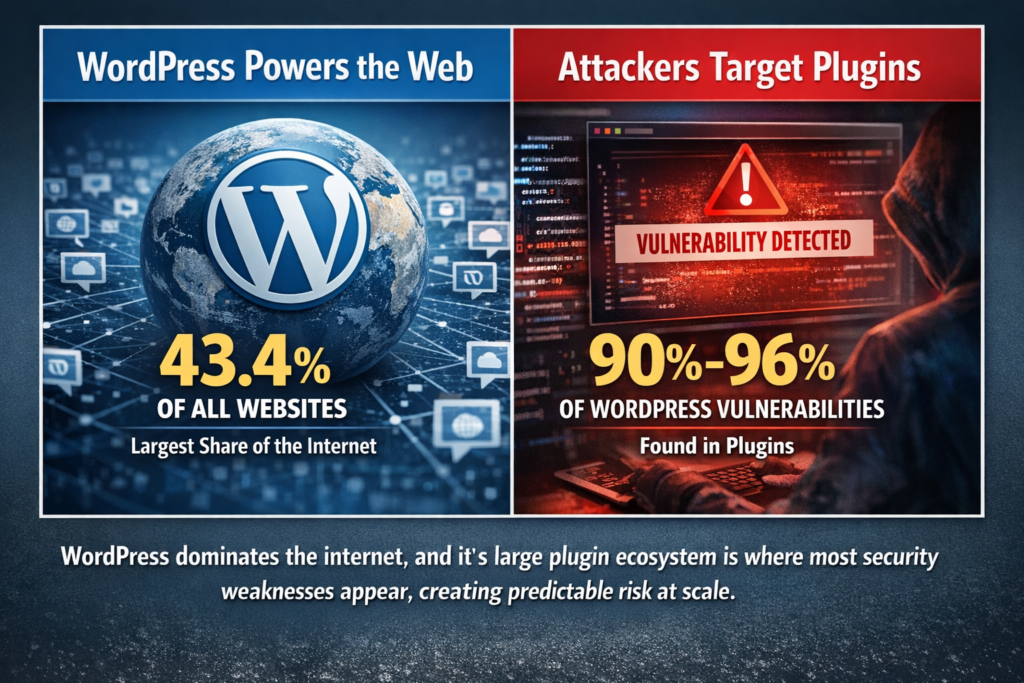
- The 2011 WordPress data breach compromised 18 million user accounts. (Kinsta)
- The 2016 Panama Papers leak, linked to an outdated Slider Revolution plugin, exposed 2.6 TB of data, 11.5 million documents and 4.8 million emails. (Kinsta)
- In 2021, SiteCheck found 4.3% of scanned WordPress sites were infected. (Wcanvas)
- A zero‑day in the WPGateway plugin led to 4 million attacks targeting 280 000 sites. (Wcanvas)
- Wordfence’s network blocked 159 billion password attack requests in 2022. (Aioseo)
- Wordfence intercepts roughly 55 million exploit attempts and 65 million brute‑force attacks every day. (Hostinger)
- Fixmysite reports 5 948 new vulnerabilities discovered in 2024—a 24% increase over 2023. (Fixmysite)
- About 58.86% of those vulnerabilities required no authentication, and 42.9% were high or critical. (Fixmysite)
- Vulnerabilities are distributed as 90% plugin, 6% theme and 4% core. (Fixmysite)
- Cross‑site scripting makes up 53.3% of new vulnerabilities; CSRF 16.9%; broken access control 12.9%. (Fixmysite)
- SEO spam causes 55.40% of malware attacks and injected malware 34.14%. (Fixmysite)
- The “Really Simple Security” plugin vulnerability affected over 4 million sites. (Fixmysite)
- Bricks Builder’s RCE bug demonstrates the danger of unauthenticated remote code execution. (Fixmysite)
- Over 827 plugins and themes were deemed abandoned in 2024. (Fixmysite)
- The Hacker News documented an attack that infected more than 1 000 WordPress sites with four different backdoors. (The hacker news)
- Another malware campaign referenced by the article compromised more than 35 000 sites. (The hacker news)
- The same report noted that at least 115 e‑commerce sites were affected by Bablosoft JS. (The hacker news)
- Attackers used five domains—mlbetjs.com, ptfafajs.com, zuizhongjs.com, jbwzzzjs.com and jpbkte.com—to deliver malicious JavaScript. (The hacker news)
- The WPBeginner analysis notes that the WPGateway vulnerability targeted 280 000 sites and involved 4 million attack attempts. (Wcanvas)
- Sucuri’s 2021 data indicates that 90% of website cleanup requests involved WordPress. (Kinsta)
- Hostinger found that a WordPress site was attacked every 32 minutes in 2025 compared with every 22 minutes in 2024. (Hostinger)
- Attack frequency equates to about 47 million WordPress hacks per year. (Electro IQ)
- Search Logistics notes nearly 13 000 WordPress sites are hacked each day. (Electro IQ)
- WPZoom lists more than 10 million installations each for Elementor, Contact Form 7 and Yoast SEO, (Electro IQ) making them primary targets for attackers.
- The top firewall plugin indicates that malware is behind 72.72% of all WordPress hackings. (Electro IQ)
WordPress Cost Impact and Recovery Patterns
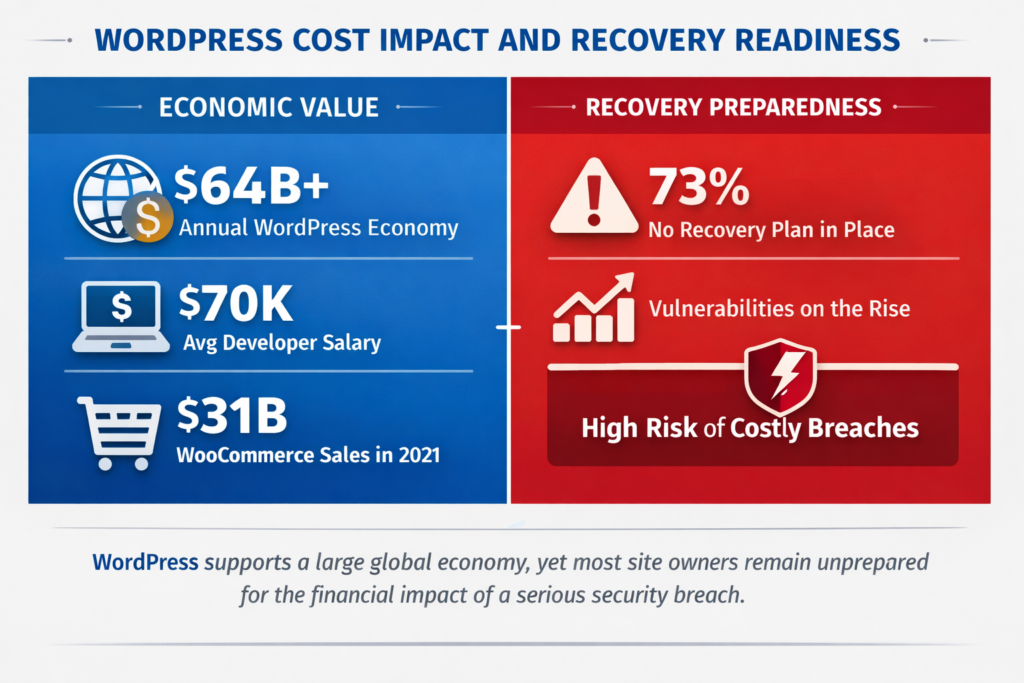
- WordPress developers earn $56 000–$111 000 annually,. (Electro IQ) and freelance rates range from $20 to $100 per hour. (Kinsta)
- Theme pricing spans $10 to $200+, with most premium themes costing around $59. (Electro IQ)
- Annual membership plans for theme and plugin clubs range between $48 and $399, averaging $145. (Electro IQ)
- Lifetime memberships average $255. (Electro IQ)
- WooCommerce plugin downloads exceed 211 million, with 30 000 downloads per day. (Red Stag)
- WooCommerce adoption is growing at 6% annually. (Red Stag)
- The WordPress ecosystem supports a global workforce of developers, designers and marketers; WP Beginner’s Facebook group alone has over 416 000 members. (Aioseo)
- Kinsta estimates that developing WordPress required 151 person‑years and a cost of approximately $8 million. (Kinsta)
- Theme creators note that 50% earn over $1 000 per month and 5% earn $10 000+, highlighting the revenue potential of premium theme development. (Kinsta)
- On the cost side of security, breach recovery planning is lacking: only 27% of WordPress professionals have a breach recovery plan. (Melapress)
- Among those outsourcing security, only 13% maintain a recovery plan, whereas 31% of organizations managing security in‑house do. (Melapress)
- Training budgets are limited—just 27% of WordPress professionals invest in team training to prevent compromises. (Melapress)
- The cost of ignoring updates is high: outdated installations cause 44% of hacks. (Fixmysite)
- Vulnerability volumes increased 24% from 2023 to 2024 (Fixmysite) implying that security budgets must rise accordingly.
- IBM’s 2024 “Cost of a Data Breach” report (not specific to WordPress) estimates the average global breach cost at around $4.45 million—a figure WordPress site owners should consider when evaluating security investments.
WordPress Cyberattacks and Human Impact on Security Teams
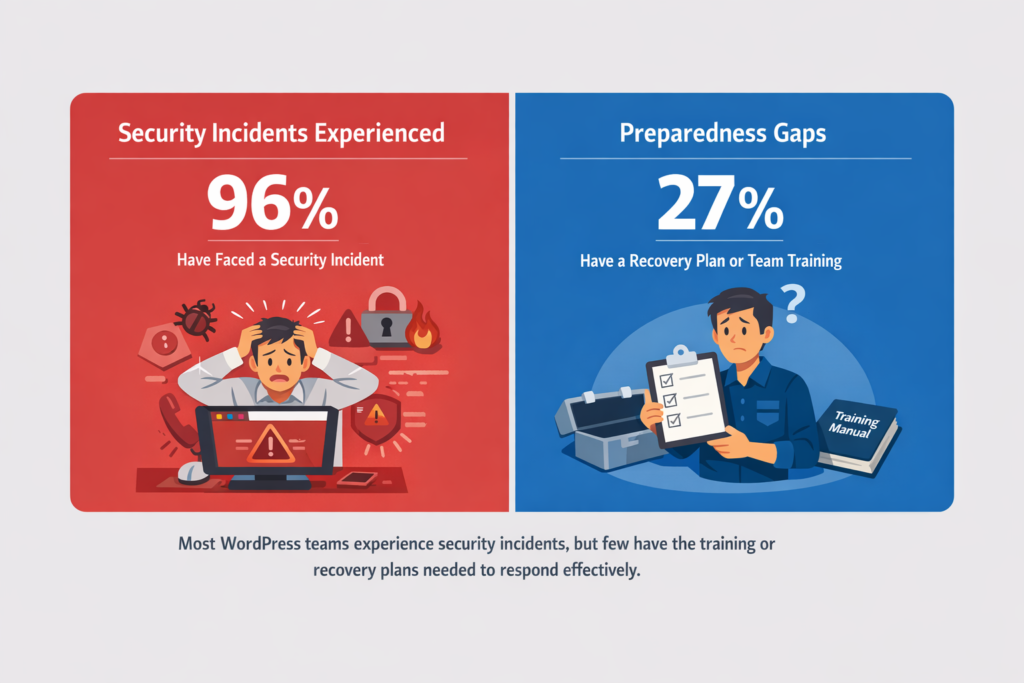
- Melapress found that 96% of WordPress professionals have experienced a security incident and 64% have suffered a breach. (Melapress)
- Respondents rate their security concern at 7.8/10 on average. (Melapress)
- Only 8% rate their concern below 5/10; 67% rate it at 8 or higher; 34% give it a full 10/10. (Melapress)
- Developers and administrators show the highest concern, with 44% of developers and 46% of admins rating their concern at 10/10. (Melapress)
- Professionals working on e‑commerce sites average 8.2/10 concern versus 7.5/10 for those on other site types. (Melapress)
- Nearly 60% of respondents list website availability as their biggest worry, 53% cite data theft/loss and 50% cite website defacement. (Melapress)
- Only 26% of respondents regard regulatory compliance as a top concern. (Melapress)
- About 32% of professionals worried about defacement or data theft do not implement any user account security controls. (Melapress)
- 37% of those concerned about defacement don’t use activity logs to monitor changes. (Melapress)
- 30% of respondents who experienced compromised accounts still lacked any security controls, and only 59% used activity logs. (Melapress)
- Only 27% of WordPress professionals invest in team training. (Melapress)
- Just 27% have a breach recovery plan in place. (Melapress)
- In organizations that manage security internally, 31% have a recovery plan; when security is outsourced, the rate drops to 13%. (Melapress)
- Only 26% of professionals concerned about compliance have a breach recovery plan. (Melapress)
- In the fixmysite analysis, 58.86% of vulnerabilities required no authentication, showing that many attacks bypass user controls entirely. (Fixmysite)
WordPress Timeline Shifts from Previous Years
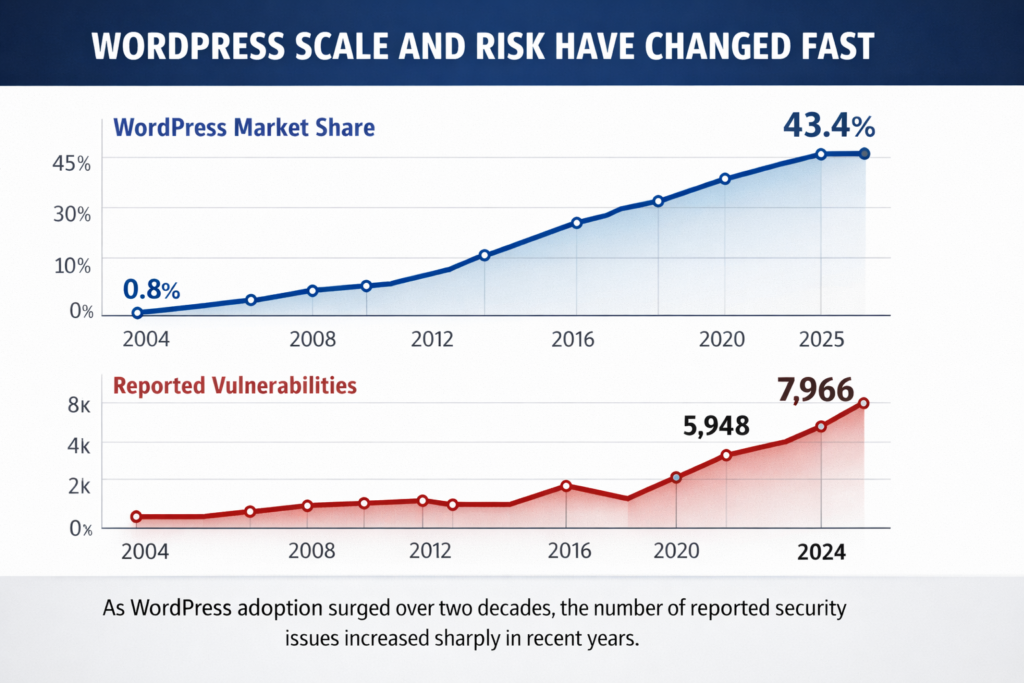
- WordPress market share grew from 0.8% in 2004 to 21% in 2014 and 43.4% in 2025. (Word Press)
- WooCommerce’s market share expanded from about 20% in early analyses to 33.4% on average by 2025. (Red Stag)
- Patchstack recorded 7 966 vulnerabilities in 2024, up from 5 948 in 2023 (a 34% increase). (Security Week) (Fixmysite)
- Hostinger observed that WordPress sites were attacked every 22 minutes in 2024 and every 32 minutes in 2025 (Hostinger)—a 45% decrease in frequency.
- The number of visits to WordPress.org fell 2.26% from May to June 2025. (Electro IQ)
- Similarweb shows Japan’s share of WordPress.com traffic decreased 11.59% month‑over‑month in June 2025. (Electro IQ)
- WordPress version 6 adoption reached 83.4% of installations in 2025, (Electro IQ) while version 5 fell to 11% and version 4 to 3.7% (Electro IQ)—demonstrating rapid adoption of newer releases.
- WordPress major releases have accelerated; eight major versions were released between 2020 and 2025. (Electro IQ)
- In 2021 48% of users ran outdated WordPress core versions (Wcanvas); by 2025 88–89% use the latest 6.x releases,. (Electro IQ) showing improved update adoption.
- Security survey results show that breach recovery planning remains stagnant: only 27% had a plan both in 2024 and 2025. (Melapress)
- The share of security incidents requiring no authentication jumped to 58.86% in 2024 (Fixmysite) from roughly 43% in earlier Patchstack reports. (Security Week)
- Credential‑stuffing attacks decreased in frequency while sophisticated plugin‑targeted exploits increased in 2024. (Fixmysite)
- Abandoned plugins and themes numbered 827 in 2024 (Fixmysite)—a notable increase from previous years when such counts were lower.
- The “Really Simple Security” vulnerability (CVE‑2024‑10924) affected more than 4 million websites, (Fixmysite) underscoring the growing scale of single‑plugin breaches compared with earlier incidents.
https://shorturl.fm/qT33I
https://shorturl.fm/3LHNy
That 43% statistic is really striking – it shows just how much of the web relies on WordPress, and therefore how important security is. I found a surprisingly relevant discussion about problem-solving skills needed for website maintenance on https://tinyfun.io/game/car-out-jam.
https://shorturl.fm/4VRMR
https://shorturl.fm/Z0sWt
becem travel | Kıbrıs araç transfer Kıbrıs araç kiralama , Kıbrıs vip araç , Kıbrıs araç transfer , Kıbrıs güvenli ulaşım
Dxd Global | Development dxd global, global dxd, deluxe bilisim, deluxe global, IT solutions, web developer, worpress global, wordpress setup
https://shorturl.fm/iOTPn
Dxd Global | Development dxd global, global dxd, deluxe bilisim, deluxe global, IT solutions, web developer, worpress global, wordpress setup
becem travel | Kıbrıs araç transfer Kıbrıs araç kiralama , Kıbrıs vip araç , Kıbrıs araç transfer , Kıbrıs güvenli ulaşım